One important post-harvest phase that impacts the end quality of your product is drying cannabis. Your buds will remain flavorful, potent, and fragrant if they are properly dried, which will increase their effectiveness and appeal. You may get great results by using the finest methods and setting up the perfect drying atmosphere.
To avoid mold and maintain quality, an efficient drying room should have constant humidity and temperature levels. Along with learning about different drying techniques, you will also learn how to proceed to the equally crucial curing stage.
Gaining an understanding of the drying process can improve your cannabis growing experience in general. Your efforts will be rewarded if you use the proper procedures and strategies to significantly increase the flavor and strength of your buds.
Important Takeaways
- Potency and taste are directly impacted by proper drying.
- The drying atmosphere is crucial for maintaining quality.
- For long-term cannabis preservation, curing is essential.
The Value of Appropriate Curing and Drying
For cannabis buds to be of the highest grade and potency, proper drying and curing are essential. These procedures have a direct impact on the product’s flavor and overall experience. You can get the greatest outcomes by being aware of the special functions that drying and curing play.
The Differences Between Curing and Drying
The first phase following harvesting is the drying process. To stop the buds from decomposing, this entails draining their moisture. Try to let it dry gradually for seven to fourteen days. Temperatures between 60°F and 70°F and humidity levels between 55% and 65% are ideal.
Curing, on the other hand, is a secondary procedure. To provide a slow release of moisture during the cannabis drying process, dried buds are placed in airtight containers. This smoothes the smoke and improves the taste. In order to give cannabinoids and terpenes time to settle, curing usually takes place over a few weeks.
Maintaining Potency and Quality
The terpenes that give it taste and scent must be maintained during the drying process. The easiest way to preserve these chemicals is to dry them slowly at a moderate temperature. Unwanted effects and unpleasant smoke might result from rapid drying.
By enabling the buds to acquire a more complex taste profile, the curing procedure further improves the cannabis. This improves the potency of the cannabinoids and enhances your smoking experience. The overall quality of the finished product can be greatly improved by proper curing.
Stopping the Growth of Mold
If your buds are not properly dried and cured, there is a significant chance that mold may emerge. An excessive amount of moisture might provide the perfect conditions for mold growth. Your entire crop might be ruined by this.
It’s critical to control humidity levels during drying. It’s critical to keep an eye on the situation and make necessary adjustments if the relative humidity level is excessive. You can more efficiently monitor moisture levels by using hygrometers. A clean and pleasurable experience is ensured by protecting your cannabis from mold with proper drying and cautious curing.
Configuring the Environment in the Drying Room
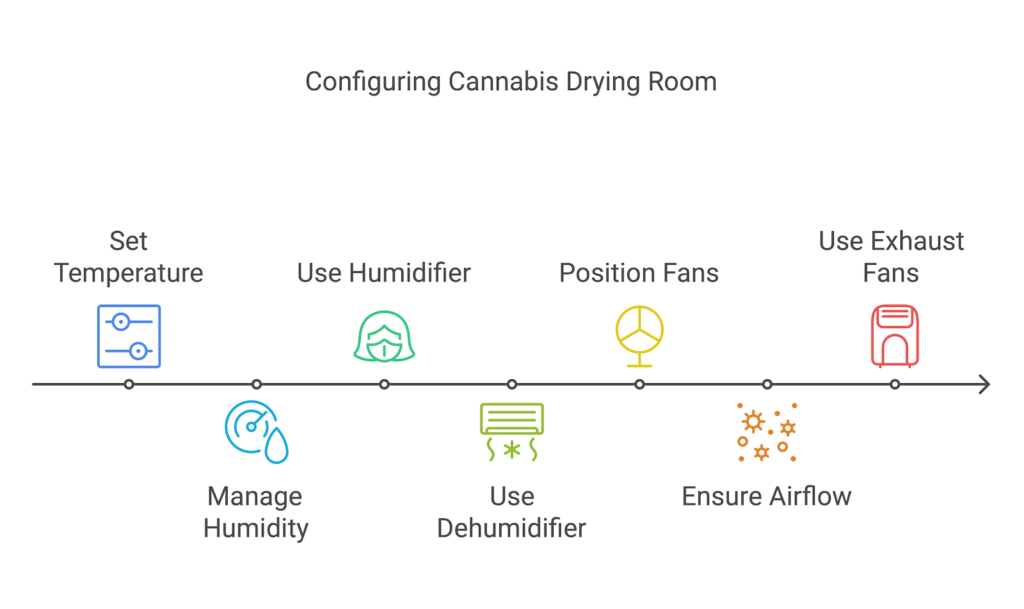
It’s crucial to create the ideal climate for cannabis drying. Maintaining adequate ventilation while regulating temperature and humidity must be your main priorities. These elements have a direct impact on the final product’s potency and quality.
Managing Humidity and Temperature
Set your drying room temperature between 60°F and 70°F (15°C and 21°C) to get the best drying results. This encourages a gradual drying process that preserves taste and strength.
It’s also crucial to keep the relative humidity between 50% and 60%. Your blossoms won’t dry out too soon or become too brittle thanks to this balance.
To keep an eye on humidity levels, use a hygrometer. Think about using a humidifier if the relative humidity is too low. On the other hand, a dehumidifier can assist in stabilizing circumstances if it’s excessively high.
Maintaining Circulation and Airflow
For uniform drying and to stop the formation of mold, airflow is essential. Fans should be positioned thoughtfully throughout the drying area to encourage steady airflow.
Ensure that there is unrestricted airflow around your cannabis. To prevent congestion, hang your buds separately or leave enough space between them on drying racks.
Additionally, proper ventilation is essential. Utilize exhaust fans to keep stale air from accumulating. This improves the drying process overall and keeps the surroundings fresh.
You can maintain the correct drying duration and preserve the quality of your cannabis by controlling airflow.
Techniques and Methods for Drying Cannabis
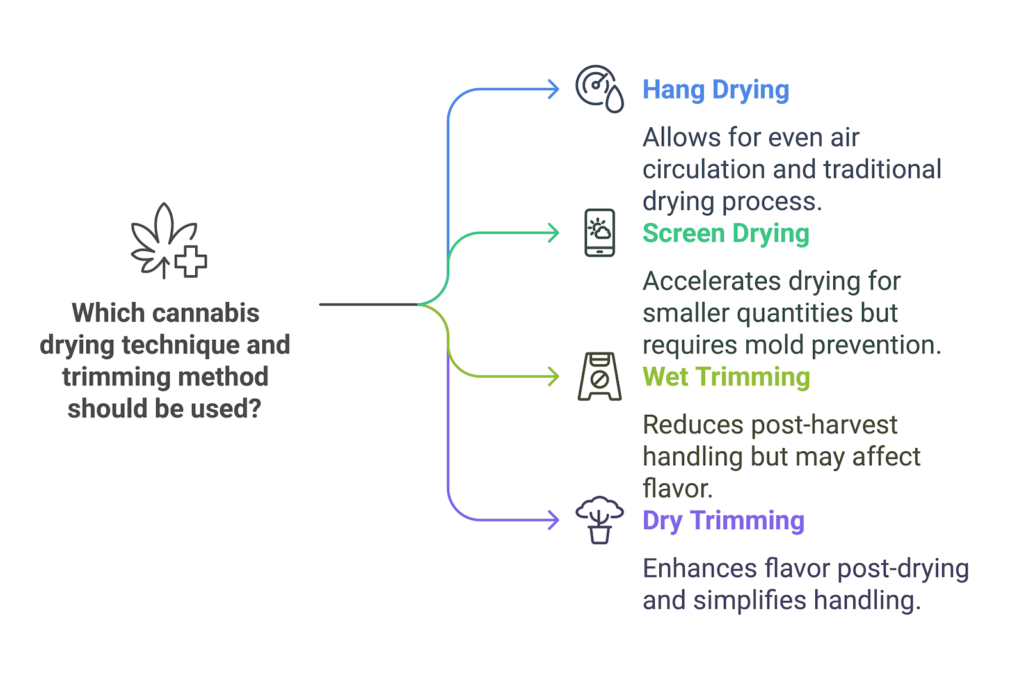
Making the correct choice while drying cannabis is essential to maintaining its flavor and potency. Each method has unique benefits that affect the process’s effectiveness and quality. Here, we’ll look at important techniques and factors to make sure drying goes well.
Comparing Screen Drying with Hang Drying
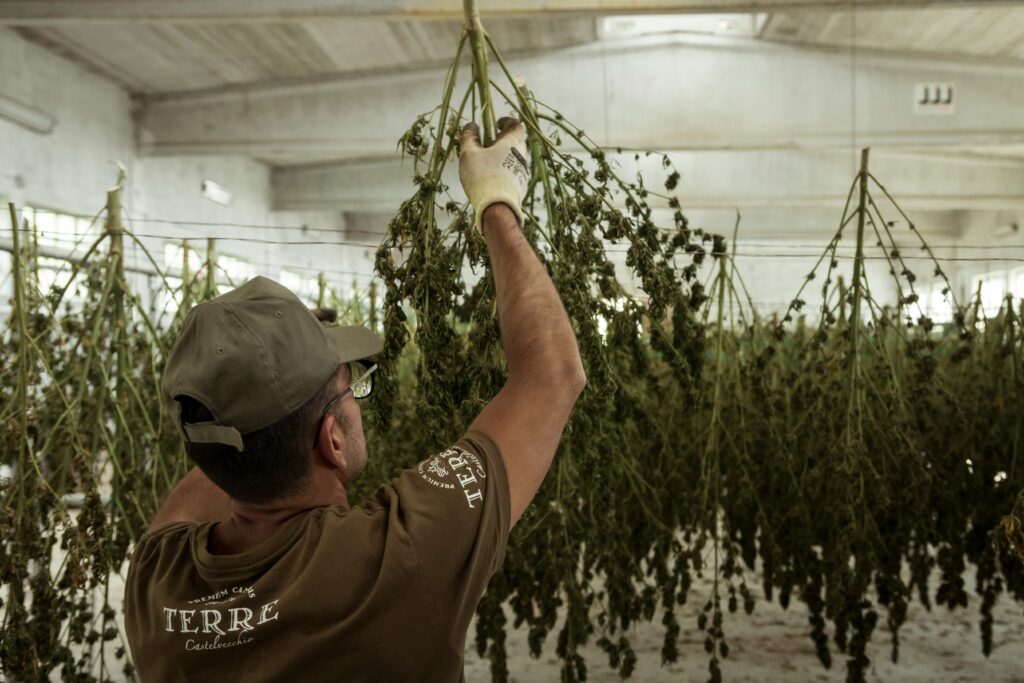
A common and traditional technique is hang drying. Branches are suspended upside down from drying racks or a wire. This procedure lets air move around the buds, facilitating equal drying. Depending on plant size and humidity levels, it usually takes 7 to 14 days.
Buds are placed on a mesh screen for screen drying. Because air circulates around the buds, this technique helps hasten the drying process. For smaller quantities of cannabis, it could work. If you choose this option, you must make sure that the spaces are adequate to prevent the formation of mold. To get the greatest results, both approaches need careful moisture level monitoring.
Comparing Wet and Dry Trimming
Cutting the buds before they dry is known as wet trimming. Immediately following harvest, you remove some sugar leaves and huge fan leaves. By accelerating the drying process, this technique may reduce the amount of leaf material that has to be handled later. However, when the plant dries with fewer leaves, some contend that it may affect flavor.
After the cannabis has dried, dry trimming is done. When the buds reach the appropriate level of dryness, you clip them. Since the buds keep the leaves wet while they dry, this technique could improve the flavor. Because the dried buds are less sticky and easier to handle, this method can also make cutting simpler.
Tracking the Moisture Content
It’s critical to maintain the right moisture content. For optimal quality, cannabis should ideally attain a moisture content of around 60%. This may be done with a hygrometer or just by feeling; buds should feel somewhat spongy within but dry on the exterior.
To prevent over-drying throughout the drying process, inspect your buds often. You run the danger of mold formation if the humidity is too high. On the other hand, if it is too low, your cannabis can lose terpenes and essential oils, which would affect flavor. Store dried buds in glass jars that allow for humidity control. This keeps the moisture content at ideal levels.
The Stage of Curing
To increase your cannabis’s flavor and potency, the curing phase is essential. The overall quality of your buds may be improved and problems like mold can be avoided with proper curing under regulated settings.
Method of Jar Curing
After drying, a common way to keep cannabis is the jar curing process. Clean glass jars with tight-fitting lids are ideal. Fill the jars about 70% of the way to the top. This provides adequate room for airflow.
Open the jars once or twice a day for ten to fifteen minutes throughout the first week. Fresh air may enter and moisture can exit as a result. Look for any indications of mold or moisture accumulation. Keep the jar open longer if you see too much moisture.
You can lower the opening frequency to once every few days after the first week. Depending on your preferences, the curing period might range from two weeks to many months. Your cannabis will get smoother and stronger the longer it is cured.
The Perfect Curing Environment
A regulated atmosphere is necessary for the proper curing of cannabis. A temperature of 60–70°F (15–21°C) and a humidity of 55–65% are optimum. Low humidity might cause your buds to become too dry, while high humidity will encourage the spread of mildew.
Jars should be kept in a dark area. Over time, light can deteriorate the quality of cannabis. Jars should also not be kept in locations with temperature swings. An effective curing procedure depends on consistent circumstances.
You will get the most taste and potency out of your cannabis if you adhere to these recommendations. When your buds are properly cured, they become a premium product that is ready for usage.
Extended Storage and Maintenance
Maintaining your cannabis requires proper long-term storage. After drying, pay attention to maintaining the proper humidity, temperature, and water content.
For storage, use airtight containers. Vacuum-sealed bags or Mason jars work well. To prevent light exposure, keep them in a cool, dark location.
Open the containers every day for the first week. This lets fresh air in and aids in releasing any moisture accumulation. You can cut this down to a few times each week after the first week.
Pay attention to the flavor and scent. Your buds may be too dry if they begin to fade. The optimal humidity level should be approximately 62%.
Signs of Correct Curing:
- A powerful, agreeable scent.
- Flavorful and silky taste.
- When bent, the stem should crack but not break entirely.
It’s crucial to use the proper equipment, such as drying racks and storage humidity packs. These aid in reaching the ideal moisture balance.
Keep in mind that this procedure is crucial to guaranteeing that your cannabis stays pleasurable and fresh for several months to come.
Commonly Asked Questions
What temperature is best for efficiently drying cannabis?
Cannabis should be dried at a temperature of 60°F to 70°F (15°C to 21°C). This range inhibits the formation of mold while preserving the terpenes and cannabinoids. By keeping the surroundings chilly, the buds may gradually dry, improving their flavor and quality.
Is it possible for high humidity levels to harm cannabis when it is drying?
Indeed, throughout the drying process, excessive humidity levels can harm cannabis. Mold and mildew are more likely to grow when the humidity level is higher than 60%. These problems may be avoided and enough drying can be achieved by maintaining humidity levels between 50% and 60%.
When drying, should cannabis plants’ leaves stay attached?
Larger fan leaves should usually be removed prior to drying. Retaining smaller sugar leaves might enhance taste and shield the buds. Eliminating extra vegetation improves ventilation and lowers the likelihood of mold growth.
What are the advantages of drying cannabis by hanging it as opposed to using a drying rack?
Better airflow around the buds is possible when cannabis is hung to dry. This technique encourages uniform drying and lowers the chance of mold growth. Although using a drying rack can also be effective, the quality may suffer since it does not offer as much airflow.
How much time should be spent drying cannabis to get the best flavor and potency?
Depending on variables like humidity and air movement, cannabis typically takes 7 to 14 days to dry entirely. Check the buds frequently to make sure they aren’t drying out too much, since this might reduce flavor and potency.
What indicators indicate that cannabis is suitable for curing once it has been adequately dried?
When the stems break instead of bend, the cannabis is ready to cure. Buds should have some moisture within but feel dry on the exterior. Cannabis that has been properly dried will also pass the “squish test,” which means that it doesn’t feel damp but keeps its shape when gently pressed.