
Key Takeaways
- As a component of the endocannabinoid system, the CB2 receptor applies to the immune system and to inflammation regulation.
- CB2 receptors are primarily located on immune system cells and throughout the body’s tissues.
- Besides autoimmune diseases and chronic inflammation, neurodegenerative diseases are being targeted with CB2 receptors with a view to maximising target efficacy.
- The use of CB2 receptors would facilitate the formulation of non-psychoactive drugs for pain relief, inasmuch as they would enable one to be high without being inebriated.
- Also, currently, ongoing research is assessing other concepts that, as of now. have gone unexplored, such as gut health, cancer receptors, and others.
The ECS has offered fresh insights into how humans remain homeostatic even when challenges are faced by multiple forces. As a part of this system, the CB2 receptor also has come to the fore as critical in modulating several biological processes in the body. Whilst it is quite often perceived as a subordinate to the CB1 receptor as regards its involvement in the synthesis of compounds that induce psychotropic effects, the rather modular roles for which the receptor has been designed suggest that it is an area that warrants greater investigation.
What is the CB2 Receptor?
CB2, which is synonymous with cannabinoid receptor type two, is a member of the elaborate fraction of g protein-coupled receptor types that are mainly distributed in the immune system or in peripheral tissues. These, alongside the CB1 receptors, are one of the two known classes of cannabinoid receptors that are associated with the endocannabinoid system. In comparison to the CB1 receptors, which are widely dispersed throughout the central nervous system and brain, the CB2 receptors can mainly be localized to the following regions:
- Spleen: Together with tonsils and other lymphoid organs, the spleen has a large number of CB2 receptors tightly expressed within them.
- B cells and Macrophages such as white blood cells. The CB2 receptor agonists have a role in skewing the immune function of human macrophages and reducing HIV-1 expression and replication in such cells.
- Peripheral Nerves
- Bone Cells
- Gastrointestinal Tract
Due to these functional sites, the CB2 receptor functions as an immunomodulator, anti-inflammatory, or tissue regenerative agent.
Structural Basis of the CB2 Receptor
Like the CB1 receptor, the CB2 receptor is also a member of the large family of G-protein coupled receptors, explaining it as seven trans-membrane domain receptors. However, the structure of the CB2 receptor is distinctly different in that it possesses a composite binding fold for ligands. These CB2 receptor structural differences enable the CB2 receptor to be activated by a whole range of ligands, such as endocannabinoids, phytocannabinoids, and synthetic cannabinoids.
As the recognition of cannabis cannabinoids as immune-modulating agents becomes increasingly accepted, such capacity of the receptor to interact with a variety of such ligands simplifies the process of virucidal action in immuno-thermodulation. These structural details of the CB2 receptor are important because they allow us to envisage the design of the drug able to act selectively at the CB2 receptor while leaving the CB1 receptor unoccupied so that no psychotropic action occurs.
Physiological Mechanism of Action of the CB2 Receptor.
Different immune cells, such as macrophages and B and T lymphocytes, as well as peripheral tissues that include the spleen, lymph nodes, and gut-associated lymphoid tissue, exhibit heightened expression of the CB2 receptor.
As for CB2 receptors found within parts of the body that are classified under the central nervous system are on microglia and astrocytes, which modulate the neuroinflammation process.
The distribution of CB2 receptors in many tissues suggests that they have a role in maintaining the balance of immune activity and participating in inflammation processes. CB2 receptors facilitate the response, which attempts to suppress and even stop the immune reactions by modulating immune cells and containing inflammation.
Phytocannabinoids and Synthetic Compounds that Act on CB2 Receptors
Similar to Cannabichromene and beta-caryophyllene, cannabinoids obtained from cannabis products act on the CB2 receptor. Terpenes found in clove and black pepper contain potent Beta-caryophyllene, a powerful CB2 receptor agonist.
Moreover, there are some efforts to make selective synthetic CB2 receptor agonists to exploit the advantage of CB2 without the undesired effects of psychoactive CB1 receptors.
Located in the periphery, the CB2 receptor is active, and although its function was first described as that of a peripheral receptor only, it is involved in immune system function regulation. It may be of use in treating some inflammatory diseases.
CB2 Receptors – Genetics and Regulation.
The CNR2 gene is encoded by the CNR2 gene and is located at chromosome 1p36.11. This gene has several transcription factors associated with its activation, including immune response actors like NF-κB and AP-1. Aside from this, CB2 receptors are also subjected to post-transcriptional control mechanisms like alternative splicing and RNA editing.
Inflammation, for example, lipopolysaccharides and cytokines, activate the NF-κB signaling pathway, facilitating CB2 receptor expression. Endogenously, cannabinoids like anandamide and 2-arachidonoylglycerol also inhibit this receptor by triggering lower-level signaling pathways.
Stimulation of the receptor CB2 suppresses the synthesis of proinflammatory cytokines and immune system cells’ functions. Also, it has been proved that it is involved in inhibiting neuropathic pain and preserving the blood-brain barrier.
The CB2 receptor, in fact, needs more focus selection because it has been proven to have relations with multiple sclerosis and rheumatoid arthritis. Furthermore, the receptor functions in the endocannabinoid system by being one of the sources and one of the enzymes that break down endocannabinoids. This enables the receptor to have additional functions of maintaining homeostasis.
In addition, it has been shown that peripheral subtype dub cannabinoid receptors 2 (CB2) targeting is anti-inflammatory and does not have the side effects of CB1 receptors. This may, therefore, be a new direction for further development.
What Are the Therapeutic Potential Uses of CB2 Receptors?
In the practice of studying the pharmacology of the CB2 receptor, cannabinoid receptor ligands like WIN 55,212–2, CP 55,940, and ∆9-THC are investigated for their ability to bind to the receptor, and they also have biological significance.
CB2 receptors have a high chance to treat:
Inflammation, Immune Responses, and Autoimmunity Disorders
The immune system’s normal response involves inflammation. It causes the development of chronic Wilms’ tumors, rheumatoid arthritis, inflammatory bowel disease, and multiple scleroses. It has been reported that activation of the CB2 receptor may help to limit inflammation by:
- Inhibiting the release of pro-inflammatory cytokines.
- Facilitating restoration of anti-inflammatory substances.
- Changing the movement and function of immune cells.
When it comes to autoimmune diseases, the activation of CB2 receptors can restore the balance between the immune system and the inflammation it has been created to treat, thus causing less damage to the affected tissues. The CB2 receptors are primarily found in immune tissues and are involved in immunological control by modulating the functions carried out by immune cells for the treatment of inflammatory diseases.
Treating Neuropathic Pain With CB2 Agonists
Chronic pain remains amongst the hardest conditions to manage – tools exist to ameliorate the situation but do not actually cure the patient. For instance, opioids — a form of conventional pain management — are highly addictive and expose people to the chance of addiction. However, the activation of the CB2 receptor does not intoxicate people since it:
- Stalls the activation of pain traits.
- Reduces nerve inflammation and damage.
- Encourages the natural tendencies of the limbs to release pain.
In the same vein, it’s said in research that CB2 agonists, which aid in activating the receptor, are good in pain management of neuropathic and inflammatory pain but are devoid of psychoactive effects.
Chronic Neurodegenerative Diseases
Neurodegenerative diseases such as Alzheimer’s and Parkinson’s diseases are characterized by neuroinflammation and oxidative damage to the brain. Glial CB2 receptors, while sparse in the brain, are hypothesized to serve the following roles:
- Diminishing neuroinflammatory responses
- Protection of neurons from oxidative damage
- Facilitation of neuron repair processes
At the same time, CB2 receptor targeting could slow the progression of the disease and improve the quality of life of the patient suffering from a neurodegenerative disease.
Therapy of Cancer
At this moment, it is possible to state that the role of CB2 receptors in cancer has double effectiveness, which is more intricate but promising. These findings suggest that the binding of a receptor CB2:
- Encourages advanced programmed cell death of cancer cells, thus restricting the expansion of the tumor.
- Reduces the mobility of cancer cells and, therefore, limits their infiltration into other normal tissues.
- Modify the microenvironment of the tumor to aid in immunological responses.
Considering this scenario, it appears logical to expect the development of CB2–selective drugs, which may someday be used together with chemotherapy in the treatment of cancer.
Guts Optimization
CB2 receptors are located in the colon as well as in its structure and function and can be considered as having functional value. They contribute to:
- Gut motility.
- Gut inflammation.
- Barrier protection.
The stimulation of these receptors has improved the course of inflammatory bowel disease and certain subtypes of irritable bowel syndrome by reducing the symptoms and promoting healing of the bowel mucosa.
What is the Future Direction of CB2 Receptor Research?
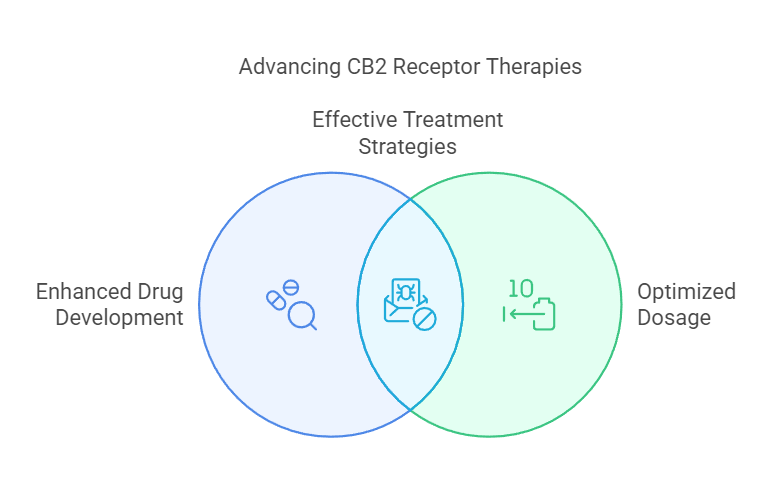
This therapy using CB2 receptors has not been as widely researched as it could have been, and there are still some questions to be clarified. Among them are:
- Enhanced Drugs Development: Progress has been made in the research of developing drugs that only target selective CB2 receptors and do not meddle with the rest of the body.
- Optimized Dosage: How frequently and for how long should the CB2 receptors be stimulated when trying to tackle particular issues is still up for discussion.
- More Clinical Trials: Before venturing into the realm of biopharmaceuticals, plenty of human clinical trials should be conducted to ascertain the final output of what these preclinical studies are trying to accomplish and to figure out the intended dose that is safe and effective.
In addition, the same trends in biotechnological and pharmacological progress allow us to imagine the appearance of CB2 therapies. Investigations are underway that combine it with many other dermatological, cardiovascular, and metabolic regulators.
Conclusion
CB2 receptors have great potential at a therapeutic level which therapists can employ. It deals with mediating immunological activity, suppressing inflammation, and protecting tissue, allowing us to solve many medical issues using a non-psychoactive molecule while avoiding the hassle of employing the CB1 receptor. At this moment in time and as a result of the dynamic process of decoding the intricacies of CB2 signaling, it is anticipated that such a receptor will revolutionize the medications we are familiar with today.
FAQ
1. What are the differences between CB1 and CB2 receptors?
CB1 receptors are mostly found in the brain and the central nervous system, where they tend to be involved in psychoactive activities, while on the other hand, CB2 receptors are found in immune and peripheral tissues with their focus being immune cells.
2. Is it possibly true that activating CB2 receptors can make a person feel high?
This statement is false. The engagement of CB2 receptors, along with its resultant actions, generates a class of therapies that are non-psychoactive, which means that there is no high that can be achieved by utilization of the receptor.
3. Are there some compounds that are obtained naturally and can spontaneously interact with the CB2 receptor?
Certainly, the compounds that interact with the receptor include cannabidiol (CBD), cannabigerol, and beta-caryophyllene, which, as mentioned earlier, occurs in many plants, such as black pepper and cloves.
4. Are there any diseases that may be treated with manipulation at the level of the CB2 receptor?
It has been proven that chronic inflammatory disorders, autoimmune diseases, and even cancer and gastrointestinal disorders might benefit from a treatment that involves the use of the CB2 receptor.
5. Is there any risk in treatment with the aim of reaching the CB2 receptors?
There are expectations that the CB2 receptor therapies will be risk-free, but finding the right kind of dose is the task. There is a lot of work or research still required in order to differentiate and locate the various risk factors.